NEW MEMBER OFFER: 1 week UNLIMITED CLASSES for $39 + HST

Official 26/27 race order and weights, station cues, pacing, compromised running and a 10–12 week plan for your first HYROX, from Toronto HYROX coaches.
Book your first classIf you've signed up for your first HYROX, or you're thinking about it, the real question is simple: how do you get ready for 8 km of running broken up by eight heavy, awkward stations, without getting hurt or blowing up halfway through?
The short answer: build an aerobic base, get strong enough that the stations don't wreck your legs, practise running on tired legs, and rehearse the whole race at least once before race day. Most beginners can do that in 10 to 12 weeks with three or four sessions a week. Below is exactly how we'd structure it.
Every HYROX race follows the same format: a 1 km run, then one station, repeated eight times. The figures below come from the official HYROX Singles Rulebook for the 26/27 season and the HYROX race overview. HYROX updates the rulebook each season, so check the current version before your race.
Sled weights include the sled itself. Note that Women Pro uses the same loads as Men Open.
In Doubles, you and a partner run every kilometre together and split the work at each station however you like. The Doubles Rulebook lists Women, Men, Mixed, Women Pro and Men Pro divisions, with Mixed using the Men Open weights. The resting partner has to stay on their feet. In the Relay, a team of four splits the race, so each person covers two runs and two stations. For a first race, Doubles is a smart way to learn the format with half the station volume.
The Roxzone is the transition area between the run course and the stations. You pass through it on the way into and out of every station, and the clock keeps running the whole time. Water is available at least once on each pass through it. Time lost here adds up fast across 16 passes, and it costs you nothing in fitness to get it back.

Running 1 km fresh and running 1 km straight off a 152 kg sled push are two different things. Your quads are full, your heart rate is high and your stride shortens. HYROX coaches call this compromised running, and it's where first-timers lose the most time.
You train it by pairing a station with a run, back to back, so your body learns to settle into pace while it's tired. A few examples:
First 200 metres off a station: shorter steps, faster feet. Let your stride come back on its own.
Don't try to hit your normal pace in the first minute. Shorten your stride, keep your cadence quick, breathe, and let the pace come back after 200 to 300 m. That's the habit you're building.
The start wave is loud, everyone is fresh and the first kilometre always feels easy. That's the trap. Here's how we'd pace a first race:
Hinge at the hips and drive the handles down with your lats and core, finishing with your hands by your thighs. The damper is preset to 6 and you can change it. Both feet must stay on the base; touching the floor earns a warning, then 15-second penalties.
Get low, arms bent with your chest close to the handles, and take short, fast steps through the balls of your feet. Each 12.5 m length must fully cross the line before you change direction.
Stand in the racers' box, lean back and walk the rope in hand over hand, using your legs and bodyweight rather than just your arms. You must stay standing, and you can't step on the box lines while holding the rope. Keep the rope out of the next lane.
Chest to the floor on every rep, then step or jump out (using a knee is allowed). Take off and land with both feet together; the rulebook allows only a 5 cm stagger. Moderate jumps with a steady rhythm beat big jumps that leave you gasping.
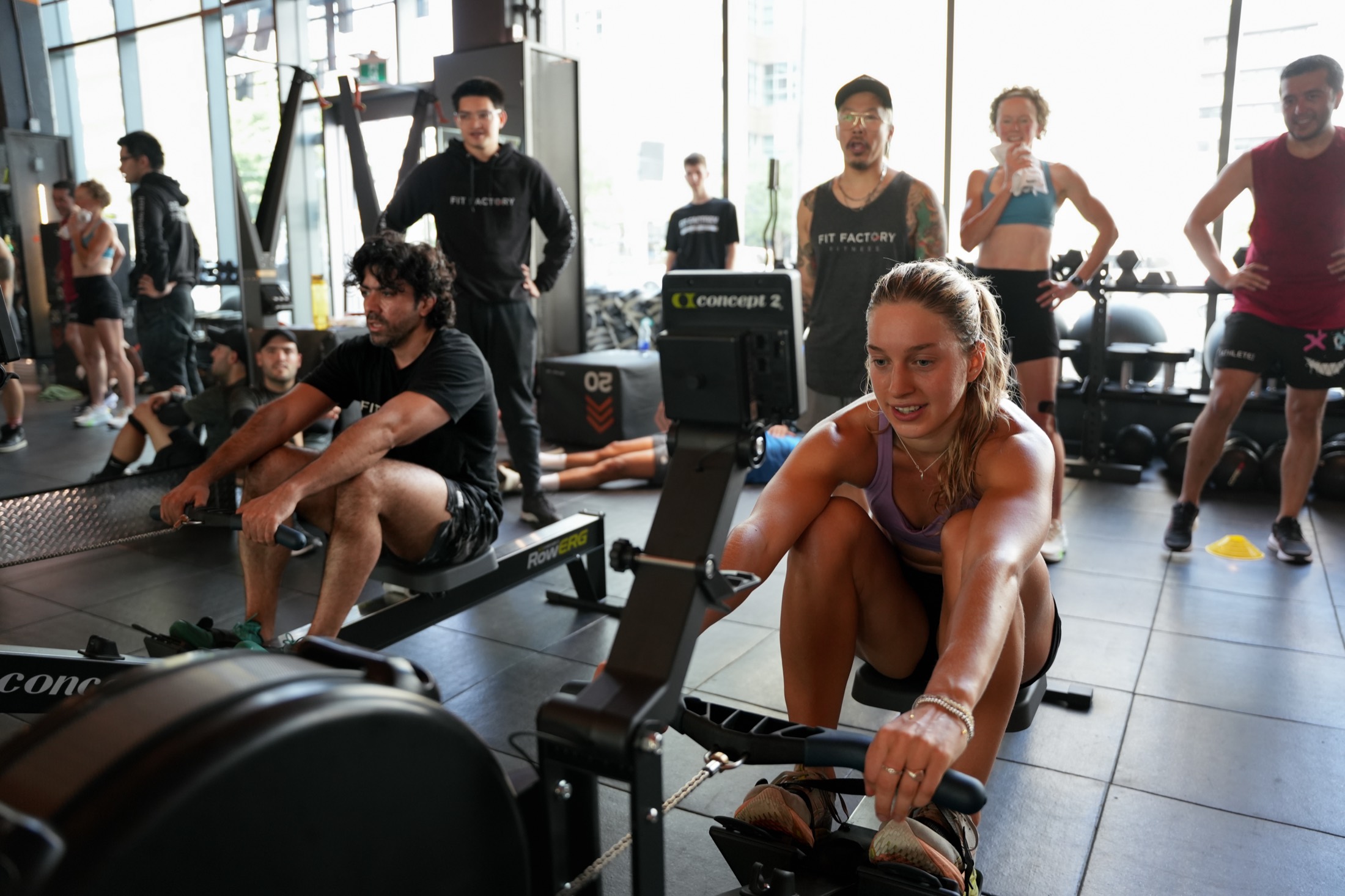
Legs, then body, then arms on the drive; reverse it on the way back. Settle into a rhythm you could hold for twice the distance. The damper is preset to 6 and the footplates to position 4, both adjustable.
Stand tall, shoulders packed, arms straight by your sides, quick steps. You're allowed to put the kettlebells down to rest as long as they don't move forward. Return them upright to the right box, or it's a 30-second penalty.
The bag stays on your shoulders the whole time; setting it down to rest is a 15-second penalty per infringement. Your back knee has to touch the ground every rep, and you have to stand tall between reps. No shuffle steps.

Start each rep standing tall with the ball in both hands, squat until your hips go below your knees, and drive the ball to the target. Catch it high and let it carry you straight into the next squat. Shallow squats and missed targets are no-reps, and there are no warnings at this station.
This plan assumes you can already run 3 to 5 km without stopping and you're comfortable with basic strength training. If you can't yet, add two to four weeks of easy running and general strength first. Do three sessions a week; add the fourth when you're recovering well.
If you're running the 10-week version, drop one base week and one build week. If you have an injury, a heart condition or another medical concern, check with your doctor before starting a plan like this.
A simulation is a dress rehearsal. Its job is to give you real numbers and a plan, not to set a personal best. Get the most from it like this:
Fit Factory is an official HYROX gym, and we host full HYROX simulations at our Downtown location. We've run seven so far, and the last two sold out with more than 100 athletes each. Our simulations use the official race format, electronic timing, race-standard equipment and a live leaderboard, with Solo, Doubles and Relay options. Between simulations, our HYROX-style classes cover running intervals, sled pushes and pulls, functional strength, conditioning and pacing, with coaches who modify for beginners. If you're racing in the city, our HYROX Toronto guide covers the event itself.
Pick your race, count back 10 to 12 weeks and book your first three sessions. If you'd like coaching for it, try our intro week for $39 + HST: a week of unlimited classes at either studio. Start at Downtown on King West or Midtown at Yonge and Eglinton, then put a simulation on the calendar before race day.
Everything you need to know about memberships, HYROX training, personal coaching, group fitness classes, and getting started at Fit Factory Toronto.
Start Your 1 week TrialFit Factory gym welcomes new members of all fitness levels with strong, open arms. No matter your fitness level, we got you.